 Agentbox
Guide
How to run multiple Claude Code agents in parallel
Three Claude Code agents running against one repository finished in 17.1 seconds of wall clock, inside the 16.4 seconds a single agent took on its own question. In bare terminal panes, finding out which of the three had finished meant opening all three.
Written 16 October 2026, rewritten 23 October against Anthropic's own documentation. Every star count, licence and commit date below was read again that day, and the dates are the last commit on each default branch rather than the figure the API hands over.
One git command gives each agent its own folder
git worktree add makes a second folder on a new branch. It runs once per task.
$ git worktree add ../app-dark-mode -b dark-mode
Preparing worktree (new branch 'dark-mode')
HEAD is now at 4a1c9f2 Snooze survives a restart
Each agent then has its own folder and its own branch, and nothing one of them does reaches another. Twenty-two of the twenty-three tools below automate that step, the exception being Agent Farm, which keeps every agent in one folder and coordinates them with lock files instead. They differ in what they show when an agent stops.
Why two agents in one folder destroy each other
Two Claude Code sessions in one directory share a working tree, so they read the same files, write the same files, run the formatter over each other and commit on top of each other.
Git never sees two versions of anything, so no merge conflict is raised. What comes out is one diff containing two half-finished changes.
Every tool below fixes this the same way, by giving each agent a folder of its own.
Anthropic ships five ways to run agents in parallel
Most roundups in this category open with tmux, which skips past the shelf of first-party answers. Anthropic's own page on running agents in parallel names five.
| What it is | How it starts | Suits |
|---|---|---|
| Worktrees | claude --worktree <name> | Two or three tasks, nothing installed |
| Agent view | claude agents | Watching many background sessions on one screen |
| Subagents | Asking for them inside a session | Splitting one task, with a lead agent merging results |
| Agent teams | /agent-teams | Coordinating several sessions automatically |
| Projects, in the cloud | claude.ai/code | Work that should survive the laptop shutting |
Agent view is the one that matters for this question. It groups sessions under Ready for review, Needs input, Working and Completed, notifies when one starts needing an answer, and moves each background session into a worktree under .claude/worktrees/ before it edits anything. Anthropic marks it a research preview.
The four ways people run agents in parallel themselves
The Claude Code CLI makes the worktree itself
Claude Code can make the worktree itself, under .claude/worktrees/<name> on a branch called worktree-<name>. For two or three tasks at a time that is the end of the problem, with nothing installed and nothing to maintain.
A tmux session and a shell script, maintained by hand
The setup is a worktree per task, a tmux pane for each and an agent in every pane, maintained by whoever built it.
Six lines will do it.
for task in dark-mode snooze-restart search-archive; do
  git worktree add "../app-$task" -b "$task"
  tmux new-window -n "$task" -c "../app-$task" \
    "claude 'work on $task, commit when the tests pass'"
done
Nothing in it reports which pane has stopped.
Claude Squad packages that loop as a terminal UI, managing one tmux session and one worktree per agent under AGPL-3.0 with no telemetry. Its last commit was 20 August 2026, which left it quiet for about two months.
Nick Khami wrote up a month of living this way before building a tool to escape it, and that write-up reached 156 points on Hacker News.
A desktop app that manages the worktrees for you
Every app in the table handles worktrees. What is left to choose between is a grid of terminals, a kanban board, a list and an inbox.
Cloud sessions, which keep running when the laptop shuts
Claude Code on the web and Codex's hosted runs move the work off the local machine. They suit a task that can be described completely, and get harder when one needs interrupting and redirecting halfway.
What actually limits how many agents run at once
Agents spend nearly all their time waiting on a model, so CPU is not the first limit. The run below put a Mac under a load average between 12 and 19 while three agents worked, which is not an idle machine, and still none of them slowed each other measurably.
The limit is attention. A terminal pane holding a finished agent looks exactly like one holding a working agent, so telling them apart means opening each one, and the agent that has been waiting twenty minutes for a yes is the one checked last.
Agent view answers exactly that, for the sessions it knows about. Four of its limits are worth knowing before leaning on it, and all four are Anthropic's own words. A session open in another terminal does not appear until it is backgrounded. Every prompt typed into agent view starts a new session rather than continuing one. Shutting the machine down stops the running sessions. And each session spends the subscription quota independently, so the docs say to read the limits before dispatching many at once.
Hacker News asked this same question four times in four months
Four Hacker News threads have asked a version of this question since March, with the scores and comment counts below as they stood on 20 October 2026.
| Date | Thread | Points | Comments |
|---|---|---|---|
| 4 Mar 2026 | Ask HN: What is the “Control Plane” for local AI agents? | 7 | 9 |
| 5 Mar 2026 | Is anyone else drowning in terminal tabs running AI coding agents? | 2 | 8 |
| 30 Mar 2026 | Ask HN: Is it actually possible to run multiple coding sessions in parallel? | 11 | 15 |
| 27 Jun 2026 | Ask HN: What GUI/desktop app do you use to keep track of different AI sessions? | 6 | 6 |
The wording moves from “control plane” in March to “GUI/desktop app” in June, and no settled name for it turns up anywhere. None of the four threads cleared 11 points either, so the people hitting this are still finding each other slowly.
What three agents at once actually cost, measured on one Mac
Each agent got its own worktree of a shallow clone of this repository. All of them started at the same moment under claude -p, each with one factual question about the code to answer. The harness recorded wall clock per agent and the machine's load average.
| Agents at once | Total wall clock | Median per agent | Fastest | Slowest | Errors |
|---|---|---|---|---|---|
| 1 | 16.4 s | 16.4 s | 16.4 s | 16.4 s | 0 |
| 3 | 17.1 s | 11.8 s | 10.9 s | 17.1 s | 0 |
Three agents finished in 17.1 seconds of wall clock, and one agent took 16.4, with no errors and no rate limit in either run.
That is not a controlled comparison, and saying so is more useful than the headline it replaced. The three agents answered three different questions and the single agent answered a fourth, which is why the three have a median of 11.8 seconds against the single agent's 16.4. An agent cannot get faster because two others are running beside it, so the gap measures the questions rather than the parallelism. What the run does establish is the ceiling, since three agents at once finished inside the time one agent took, and no run has yet been done on a quiet machine with every agent asked the same question.
The tasks were small and read-only, so this measures what parallelism costs rather than how fast Claude writes code. The Mac carried a load average between 12 and 19 throughout. Six and ten agents remain untested.
Where each tool puts the worktrees it creates
No two of the tools agree on where the worktree folder should go, so the README of whichever one is running is the only reliable answer. Somebody who built a worktree cleaner to deal with it wrote on Hacker News on 15 October 2026 that Codex, Claude Code, Orca and Superset each put their worktrees somewhere different, which made them hard to find. That post drew one point and no replies, so this is one person's annoyance rather than a groundswell.
Agentbox uses the middle layout, .claude/worktrees/<task id>, with a branch of the same name, so every task does its work inside the repository it belongs to. The worktree guide covers cleanup and the empty node_modules that catches everyone once.
Twenty-three tools, read on 23 October 2026 UTC
Roundups in this category list between four and nine tools and mostly copy that list from the previous roundup. A pass through GitHub that reads the licence and the last commit of every candidate turns up twenty-three. The dates are the last commit on each project's default branch, which is not the date the API hands over and is the one that catches a quiet project.
| Tool | Stars | Licence | Last commit |
|---|---|---|---|
| Orca | 102,844 | MIT | 23 Oct 2026 |
| Vibe Kanban | 28,434 sunsetting | Apache-2.0 | 19 Sep 2026 |
| cmux | 28,355 now a terminal | GPL-3.0 | 22 Oct 2026 |
| opcode | 22,418 | AGPL-3.0 | 18 Sep 2026 |
| Superset | 15,479 | Elastic 2.0 | 23 Oct 2026 |
| CloudCLI, was claudecodeui | 14,249 | AGPL-3.0 | 22 Oct 2026 |
| Claude Squad | 8,649 | AGPL-3.0 | 20 Aug 2026 2 months quiet |
| Emdash | 6,057 | Apache-2.0 | 22 Oct 2026 |
| Crystal | 3,131 deprecated | MIT | 26 Feb 2026 7 months quiet |
| Nimbalyst | 1,960 | MIT | 23 Oct 2026 |
| Nezha | 1,908 | GPL-3.0 | 16 Sep 2026 |
| ccmanager | 1,270 | MIT | 18 Oct 2026 |
| Agent Farm | 922 | MIT, with a rider | 21 Sep 2026 |
| agentbox (sandboxes) | 544 name collision, different project | MIT | 23 Sep 2026 |
| harnss | 391 | MIT | 19 Jun 2026 4 months quiet |
| Hermes IDE | 342 | BUSL-1.1 | 15 Oct 2026 |
| devteam | 265 | MIT | 25 May 2026 5 months quiet |
| Terragon | 261 dead | Apache-2.0 | 10 Feb 2026 8 months quiet |
| mulmoterminal | 244 | MIT | 22 Oct 2026 |
| Sculptor | 240 | MIT | 20 Oct 2026 |
| Agentbox | 94 the app behind this page | GPL-3.0 | 23 Oct 2026 |
| grove | 47 | MIT | 21 Oct 2026 |
| Conductor | no public repo | Closed | Free, Pro $50/mo |
Seven of the twenty-three are dead, renamed or have gone quiet
Vibe Kanban is sunsetting, announced 10 April 2026, and still appears on most of the recommendation lists in this category. Crystal is deprecated and its own description now points at Nimbalyst, and cmux has become a macOS terminal rather than an orchestrator.
Three more have gone quiet without saying so, which is the kind a list never catches. harnss last moved its default branch on 19 June, devteam on 25 May, and Claude Squad on 20 August. harnss is worth singling out, because its pushed_at reads 21 October and about sixty-five side branches keep it looking busy to anybody reading the easy field.
madarco/agentbox is a seventh kind of not-what-it-looks-like. It runs agents in Docker containers rather than orchestrating local CLIs, and it shares the Agentbox name and had it first.
Questions about running several agents at once
Can you run multiple Claude Code agents at once?
Yes, once each one has its own directory, and Claude Code has settings for exactly this. claude --worktree <name> makes the directory, worktree.baseRef chooses what it branches from, and isolation: worktree in a subagent's frontmatter makes it permanent for that agent. In the desktop app the Worktree toggle is per session and off by default.
How many agents can I run?
Three ran with no measurable penalty. Past that is untested here, and the ceilings other pages print carry no source. Rate limits and human attention both give out before the machine does.
How do I run multiple agents in VS Code?
The extension does it on its own. Its sessions list sits in the Activity Bar, and Open in New Tab or Open in New Window runs several conversations at once, each resumable from history. Pairing that with claude --worktree gives each one its own checkout.
What is the best way to manage multiple Claude Code sessions?
Below three agents, tabs are fine. Above three, pick from the table of twenty-three.
Can I run multiple Claude Code accounts?
Several agents on one subscription is ordinary use. Several accounts to dodge the limits breaks Anthropic's terms, and nothing here helps with it.
Questions about git and safety
Is it safe to run several agents in worktrees at the same time?
Yes for files. Agents cannot reach into each other's checkouts. They do share the git object store, which git handles, and everything outside git, which it does not. A dev server on a fixed port is the collision people actually hit.
What happens when two agents want the same file?
Nothing. In separate worktrees they are different files on disk. The conflict waits until merge time and git treats it like any other two branches.
Worktree or just a branch?
A branch is enough for one thing at a time. Two things at once need two folders.
How do I clean up afterwards?
$ git worktree remove ../app-dark-mode
$ git worktree prune          # drop records whose folders are gone
$ git branch -d dark-mode     # the branch is separate
Removing a worktree never deletes its branch, so a tidy git worktree list can sit beside a git branch output thirty lines long. remove also refuses while the folder has uncommitted changes, and --force overrides it. Thirteen commands cover the whole lifecycle.
Questions about cost and limits
Do these tools cost extra on top of Claude Code?
Most of them are free and run on an existing Claude Code or Codex subscription. Conductor charges $50 a month for Pro, which buys agents running in its cloud. Anything that asks for an API key bills separately from that subscription.
Will I hit a rate limit?
Not at three. Ten depends on the subscription tier and on how hard each agent is working. A limit arrives as an API error inside the agent that hit it rather than as a crash.
Does running ten agents slow my machine down?
Barely. The agents are waiting, not computing. What it does cost is a fresh node_modules per worktree.
$ git worktree list | wc -l
       7
$ du -sh ../app-*/node_modules | tail -1
417M	../app-snooze/node_modules
Seven worktrees of a typical Node project is a few gigabytes of the same dependencies. On macOS a block-sharing copy avoids most of it.
Questions about watching and reviewing
How do I review what five agents did?
Five finished branches are five diffs to read, whatever tool produced them. The thing worth having is one that shows the diff in the same window.
Can I check on agents from my phone?
Anthropic gets there first. Claude Code runs at claude.ai/code in a mobile browser and in the Claude apps for iOS and Android, and Dispatch pushes a notification when a desktop session finishes or needs approval. Among the twenty-three, Orca ships iOS and Android, Nimbalyst an iOS companion, Superset an iOS app on its paid tier, and Conductor one on Pro. Agentbox has none of them.
Does a GUI actually help, or is the terminal fine?
Under three agents an app is overhead. Over three it pays for itself in tabs nobody has to open. Twenty-one front ends exist, in four shapes.
Which tool fits which need
What Agentbox does with worktrees and the inbox
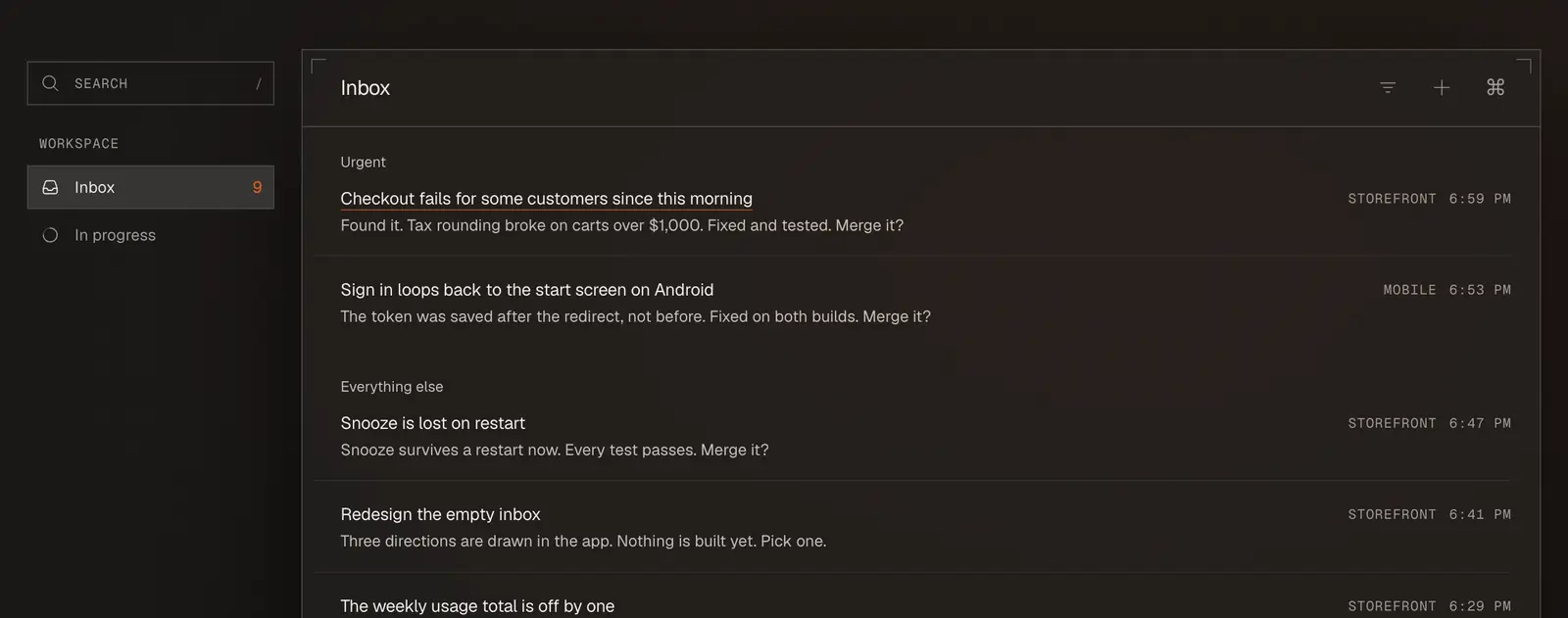
Every task gets a worktree, a branch and an agent of its own, and when one finishes or gets stuck its row comes back to the top of the inbox to be answered, approved or closed. The terminal and the diff sit in the same window.
It runs Claude Code and Codex locally on an existing subscription, with no server in the middle, no account to make and no API key anywhere in it.

Where Agentbox loses
The first thing Agentbox loses to is Anthropic. The desktop app comes with the subscription, it is supported, and it will follow every change to Claude Code before anybody else can. Anyone who only runs Claude Code, on one machine, should try claude agents and the Code tab before installing anything from the table above, including this one.
Against the rest, Agentbox is four weeks old with 94 stars to Orca's 102,844. There is no native Windows build, where Orca, opcode, Emdash, Nimbalyst and three others ship one. There is no mobile app, where Orca ships two. And there is no company behind it, where Conductor sells somebody to call.
Agentbox
Run dozens of Claude Code and Codex agents in parallel, each in its own git worktree, and only hear from the ones that need you. Free and open source.