 Agentbox
Guide
Is there a GUI for Claude Code?
Yes, and Anthropic ships it. The Code tab in the Claude desktop app runs sessions in parallel, each optionally in its own git worktree, with an integrated terminal and a diff view, on macOS, Windows and a Linux beta. The CLI has claude agents, which groups every background session under Needs input and Working. Twenty-one third-party front ends exist beside those, and the question worth answering now is which of them still beats them.
Written 16 October 2026, rewritten 23 October against Anthropic's own documentation. Every star count, licence and commit date below was read again that day, and the licences were read from each project's LICENSE file where the API could not name one.
Anthropic ships Claude Code for the desktop, the browser, two editors and the terminal
Anthropic's overview page opens with the sentence that settles the question. Claude Code is "available in your terminal, IDE, desktop app, and browser".
| Surface | Runs on | Several agents at once |
|---|---|---|
| Desktop app, the Code tab | macOS, Windows x64 and ARM64, Linux beta | Yes, from a sidebar |
| Web, at claude.ai/code | Any browser, plus the iOS and Android apps | Yes, and a project coordinates them |
| VS Code extension | VS Code and Cursor | Yes, in separate tabs or windows |
| JetBrains plugin | IntelliJ, PyCharm, WebStorm and others | Needs the CLI installed separately |
| Terminal CLI | macOS, Linux, WSL, native Windows | Yes, through claude agents |
A paid Claude subscription covers the desktop app, which bundles Claude Code so the CLI need not be installed first.
What Anthropic's desktop app can do
Anthropic's own list for the desktop app reads "parallel sessions with Git isolation, drag-and-drop pane layout, integrated terminal and file editor, side chats, computer use, Dispatch sessions from your phone, visual diff review, app previews, PR monitoring, connectors, and enterprise configuration".
Several sessions run at once from the sidebar. Turning on Worktree puts a session in its own git worktree, which is off by default and needs git installed. The app sends an operating system notification when a session finishes a task and nobody is looking at that session. Sessions run on the local machine, in the cloud, or over SSH, and the cloud ones keep going after the laptop shuts.
The terminal has its own version, called claude agents
claude agents opens one screen for every background session. It groups them so the ones needing an answer sit at the top, under the headings Ready for review, Needs input, Working and Completed, and it sends a notification through the terminal's notification channel when a session starts needing input, finishes or fails.
It also isolates them without being asked. Before a background session edits a file, Claude moves it into a worktree under .claude/worktrees/, so parallel sessions read one checkout and each writes to its own.
Anthropic marks the feature a research preview and says the interface and shortcuts may change.
Six things Anthropic's app and claude agents still do not do
Four of the limits below are Anthropic's own, published in the agent view documentation, and the rest are plain properties of a first-party tool.
- An interactive session open in another terminal does not appear until it is backgrounded.
- Every prompt typed into agent view starts a new session rather than continuing one.
- Shutting the machine down stops the running sessions, though sleep is handled.
- Each session spends the subscription quota independently, so the docs say to read the limits before dispatching many at once.
- It drives Claude Code. Codex and the other coding CLIs are somebody else's problem.
- The sidebar is a list of sessions rather than a board, and nothing orders them by which task matters most.
Those last two are why most of the twenty-one tools below exist, and the first four are why the terminal still loses people.
A session started in an ordinary terminal and never backgrounded is still a pane that looks identical to every other pane.
The four kinds of third-party front end
Editor plugins are missing from this list because the two that matter are Anthropic's own, covered above. What is left splits four ways, and the counts come from the table below rather than from a guess.
Eleven of the twenty-one are desktop apps for running many agents
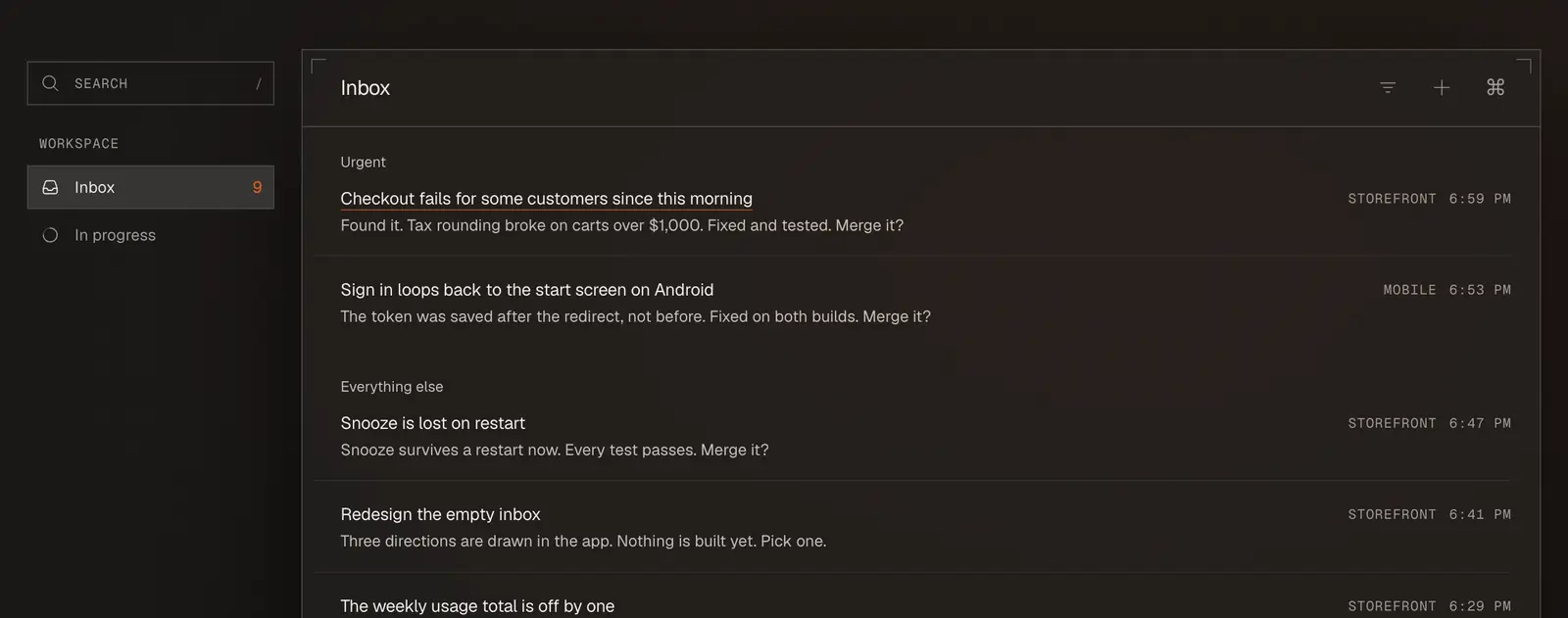
Each agent gets its own git worktree, and the app becomes the place where all of them are watched. They differ mainly in the form of the thing that reports an agent has stopped, which is a grid, a board, a list or an inbox.
Five of the twenty-one are terminal interfaces, not graphical ones
Claude Squad, ccmanager, devteam, grove and Agent Farm draw their interface in the terminal rather than in a window. Counting them among graphical front ends is a stretch, and they are here because every roundup in this category lists them.
Three of the twenty-one run in a browser
A web UI runs on a local machine or on a rented box and opens in a browser, which is the only one of the four shapes that reaches a phone without a native app. claudecodeui is the largest of the three.
One of the twenty-one is a terminal emulator built for agents
cmux adds tabs, status indicators and notifications over the same text that was there before, having moved from orchestration to being a Ghostty-based macOS terminal.
Twenty-one front ends, read on 23 October 2026 UTC
Other roundups list four to nine tools and copy each other's choices, and some of what they print carries no findable source at all. The last column is the one to read first, and it is the last commit on each project's default branch rather than the figure the API hands over.
| Project | Runs on | Licence | Stars | Last commit |
|---|---|---|---|---|
| Orca | macOS, Windows, Linux, phone | MIT | 102,844 | 23 Oct 2026 |
| Vibe Kanban | macOS, Windows, Linux | Apache-2.0 | 28,434 sunsetting | 19 Sep 2026 |
| cmux | macOS, phone | GPL-3.0 | 28,355 now a terminal | 22 Oct 2026 |
| opcode | macOS, Windows, Linux | AGPL-3.0 | 22,418 | 18 Sep 2026 |
| Superset | macOS, Linux, phone | Elastic 2.0 | 15,479 | 23 Oct 2026 |
| claudecodeui | macOS, Windows, Linux, phone | AGPL-3.0 | 14,249 now CloudCLI | 22 Oct 2026 |
| Claude Squad | macOS, Windows, Linux | AGPL-3.0 | 8,649 | 20 Aug 2026 2 months quiet |
| Emdash | macOS, Windows, Linux | Apache-2.0 | 6,057 | 22 Oct 2026 |
| Crystal | macOS, Linux | MIT | 3,131 deprecated | 26 Feb 2026 7 months quiet |
| Nimbalyst | macOS, Windows, Linux, phone | MIT | 1,960 | 23 Oct 2026 |
| Nezha | macOS, Windows, Linux | GPL-3.0 | 1,908 | 16 Sep 2026 |
| ccmanager | macOS, Windows, Linux | MIT | 1,270 | 18 Oct 2026 |
| Agent Farm | macOS, Linux | MIT, with a rider | 922 | 21 Sep 2026 |
| harnss | macOS, Windows, Linux | MIT | 391 | 19 Jun 2026 4 months quiet |
| Hermes IDE | macOS, Windows, Linux | BUSL-1.1 | 342 | 15 Oct 2026 |
| devteam | macOS, Linux | MIT | 265 | 25 May 2026 5 months quiet |
| mulmoterminal | macOS, Windows, Linux, phone | MIT | 244 | 22 Oct 2026 |
| Sculptor | macOS, Linux | MIT | 240 | 20 Oct 2026 |
| Agentbox | macOS, Linux | GPL-3.0 | 94 the app behind this page | 23 Oct 2026 |
| grove | macOS, Windows, Linux, phone | MIT | 47 | 21 Oct 2026 |
| Conductor | macOS, phone | Closed | no public repo | Free, Pro $50/mo |
Six of the twenty-one are dead, renamed or have gone quiet
Three have said so themselves. Vibe Kanban is sunsetting, with the notice above the screenshots in its own README, linking the announcement from 10 April 2026. Crystal is deprecated, and its description now opens "Crystal is now Nimbalyst". cmux is a macOS terminal now rather than an orchestrator, and it is one of the most active repositories on the list.
Three more have simply gone quiet, which nothing announces. harnss last moved its default branch on 19 June, devteam on 25 May, and Claude Squad on 20 August. harnss is the one worth knowing about, because its pushed_at reads 21 October and sixty-five side branches keep it looking busy.
All six still turn up on recommendation lists written this year. The default-branch commit date is what catches them, and it is the column those lists do not carry.
Four questions worth asking about any of these tools
The screenshots are the least useful part of every project page on the list.
The first question is whether the interface shows which agents are waiting without each one being opened, the second is whether it isolates each agent in its own worktree or lets them share a folder, the third is whether it runs on a Claude subscription or wants an API key, and the fourth is when it last got a commit.
The commit date most roundups print is the wrong one
The obvious way to answer the fourth question returns a date that can be months newer than the truth. Taking harnss, which is in the table above.
$ gh repo view OpenSource03/harnss --json pushedAt
{"pushedAt":"2026-10-21T07:07:52Z"}
pushedAt moves when anything is pushed to any branch, including a branch nobody ever merges. The date that answers the question is the last commit on the branch a reader would install from, which for harnss is master rather than main.
$ gh api repos/OpenSource03/harnss/commits/master --jq .commit.committer.date
2026-06-19T...
Four months separate those two readings of the same repository, and the newer one is what makes a quiet project look busy. Every date in the table above is the second kind, which is the one roundups in this category almost never use.
Three problems no front end fixes
None of the twenty-one front ends fixes the three things below.
Reviewing the work. Five finished agents mean five diffs to read, and that reading is the slowest part of the whole loop. An app can put the diff on screen, but it cannot decide whether the change is right.
Writing the task. A vague instruction produces a vague branch, and running ten agents at once multiplies the vagueness.
The limits of a subscription plan. Ten agents that trip a rate limit trip it in every tool on the list, because no interface changes what a subscription tier allows.
Questions about getting a GUI
Does Claude Code have an official GUI?
Yes. The Code tab in the Claude desktop app, on macOS, Windows and a Linux beta, with a paid subscription. It runs several sessions at once from a sidebar, puts each in its own git worktree when Worktree is turned on, and carries an integrated terminal, a file editor and a diff view. The CLI also has claude agents, which groups sessions under Needs input, Working and Ready for review.
How do I install a Claude Code GUI?
Most are a normal download or a one-line npm command. Agentbox runs without being installed at all.
$ npx agentbox-app
Agentbox is running at http://127.0.0.1:51734/?k=9f3c2a
Press Ctrl-C to stop.
It listens only on 127.0.0.1, the key changes every run and nothing is hosted.
Is there a free and open-source option?
Seventeen of the twenty-one are, under MIT, Apache-2.0, AGPL-3.0 or GPL-3.0. Four are not. Superset is Elastic License 2.0, Hermes IDE is Business Source License 1.1, Agent Farm is MIT with a rider barring use in machine learning training, and Conductor is closed and has no public repository. Conductor does have a free tier, so "not open source" and "not free" are different lists here.
Is there one for Windows?
Anthropic's own desktop app ships Windows x64 and ARM64 installers, and the CLI installs with winget install Anthropic.ClaudeCode, so the first answer here is first-party. Among the twenty-one, Orca, opcode, Emdash, Nimbalyst, Nezha, harnss and Hermes IDE ship Windows builds. Nezha states no platforms in either of its READMEs, so that one is read from its release assets instead.
Is there one for Linux?
Anthropic's desktop app has a Linux beta, installed with apt or a .deb on Ubuntu and Debian. Among the twenty-one, the same seven that ship Windows mostly ship Linux too, plus the terminal interfaces and anything that runs in a browser. Agentbox installs on Linux from a checkout and adds a launcher entry, and npx agentbox-app works anywhere Node 22 does.
Can I run one in a browser or on my phone?
Anthropic reaches a phone first, through claude.ai/code in a mobile browser and the Claude apps for iOS and Android, and Dispatch pushes a notification when a desktop session finishes or needs approval. Among the twenty-one, Orca ships both an iOS and an Android app, Nimbalyst ships an iOS companion, claudecodeui runs in any mobile browser, Superset's iOS app needs its paid tier, and Conductor's mobile app needs the $50 Pro plan.
Questions about the terminal
GUI or CLI, which should I use?
Below three agents, the terminal is fine and an app is overhead. Above three, the app starts paying for itself, because the cost it removes is the tab-checking rather than anything the machine does.
Is a GUI slower than the terminal?
No, because the agents wait on a model rather than on the interface. Three agents started together finished inside the time a single agent took, and the front end accounts for none of that. The timings and the method are here.
What about a TUI instead?
Claude Squad, ccmanager, devteam and grove and Agent Farm are terminal interfaces rather than graphical ones, and the twenty-one includes all five. They stay in one window, carry no Electron, and suit people who already live in tmux. claude agents now covers much of the same ground without installing any of them.
Can I use one over ssh?
Anthropic's desktop app runs sessions over SSH on a remote machine, which it lists beside local and cloud as one of three environments, so the old answer that desktop apps cannot do this is no longer right. Among the twenty-one, a terminal interface works over ssh by its nature, and a web UI needs only a forwarded port and a browser.
Questions about how they work
Do these use git worktrees?
The ones that run several agents at once nearly all do, because two agents in one folder overwrite each other. Making a worktree is one command, and the repository lists whatever a tool has created.
$ git worktree list
/Users/you/app              4a1c9f2 [main]
/Users/you/app/.claude/worktrees/w-7c21   8b31e07 [agentbox/w-7c21]
A stale worktree holds a branch and a lock file until it is removed, which is one more command.
Will it cost extra on top of my Claude plan?
Most run on an existing Claude Code or Codex subscription, and Conductor charges $50 a month for Pro. The thing to check is whether a tool asks for an API key, because that bills separately from the subscription.
Can it run Codex as well as Claude Code?
Some can. Agentbox runs Claude Code and Codex side by side on the same board, with neither of them as the default.
What happens to my repository?
Each task gets a worktree and a branch, to merge or delete when it is done. A local tool sends nothing anywhere and leaves the existing branches alone.
How to check every number in the table yourself
Every figure in the table was read on 23 October 2026 UTC, and the check fits in four lines. It asks for the default branch first, then the last commit on it, which is the step the pushed_at shortcut skips.
for r in stablyai/orca OpenSource03/harnss smtg-ai/claude-squad; do
  b=$(gh api repos/$r --jq .default_branch)
  gh api repos/$r/commits/$b --jq "\"$r \(.commit.committer.date[0:10])\""
done
Licences needed a second step for four of the twenty-one. The API answers NOASSERTION for cmux, Superset, Hermes IDE and Agent Farm, so those four were read from the LICENSE file itself. cmux is the one that matters, because the API's silence hides that everything a reader downloads is GPL-3.0 and only six server directories are not, and a table trusting the API alone marks the whole project source-available.
The platform and shape columns come from each project's README and its release assets. Nezha states no platforms in either README, so its row is built from the installers it publishes. Where a project calls itself source-available rather than open source, the table repeats that wording, because the distinction matters to the people who go looking for an open-source option.
Can I use one with a local model?
Some front ends allow pointing Claude Code at a different endpoint, which is a Claude Code setting rather than something the interface provides. Most of the tools assume the hosted model and say nothing either way, so the project's README is the place to look for it.
Will it keep working when Claude Code changes?
Most tools here drive the CLI by shelling out to it, so one change to the CLI can break several at once. harnss is the exception, speaking the Agent Client Protocol instead, which is a published boundary rather than screen scraping. What protects against the rest is a recent commit on the default branch, which is the column most roundups get wrong.
What happens to my shell setup, aliases and hooks?
A desktop app usually spawns its own shell, so a login-shell alias may be missing. Anything configured inside Claude Code travels with it, because the app runs the same binary as the command line.
What Agentbox does that Anthropic's app does not
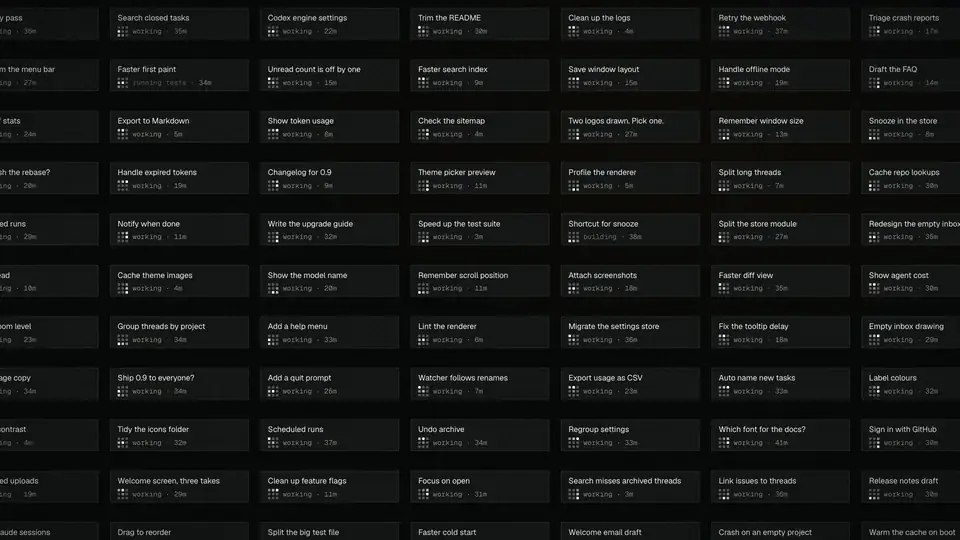
Every task in Agentbox gets its own git worktree, its own branch and its own agent, and all of them run at the same time. When one finishes or gets stuck, its row comes back to the top of the inbox, to be answered, approved or closed. There is a board as well as the inbox, and the terminal and the diff are built in.
Three of those differ from Anthropic's own app rather than repeating it. Claude Code and Codex run side by side on the same board, on whichever subscription each task should spend. Projects can be ranked so the most important work starts first, where a sidebar is an undifferentiated list. And it runs in a browser through npx agentbox-app, which reaches Linux and Windows without a build for either.
Everything runs locally on an existing subscription, with no server in the middle, no account and no API key.
Try Anthropic's own app before installing a third-party one
The desktop app comes with a Claude subscription and claude agents costs one command, and between them they cover what most people came to this page for. Anything on the list below has to beat that rather than beat a bare terminal.
What is left to choose on is narrower than it was. Windows narrows the twenty-one to seven, a phone to five, wanting to read the source removes four, and wanting a support contract leaves only Conductor.
Where Agentbox loses
The competitor that matters most is Anthropic, and it wins on the things a first party wins on. The desktop app is supported, it is included in a subscription, it will track every change to Claude Code before anybody else does, and it reaches a phone through Dispatch and the Claude apps. Agentbox has none of that.
Against the twenty-one, Agentbox is four weeks old with no native Windows build, where Orca, opcode, Emdash, Nimbalyst and three others ship one, and no mobile app, where Orca ships iOS and Android. If any of those is the deciding thing, the table above says who to use instead.
Which front end to pick, by what matters most
Agentbox
A desktop GUI for running dozens of Claude Code and Codex agents in parallel, each in its own git worktree, and only hearing from the ones that need you. Free and open source.